

MAR.2024

Recommendations
A Country You Can Leave
Asale Angel-Ajani

A Country You Can Leave is the definition of complicated love. The love story that is often fraught with bitterness and unwavering piousness – that of the love between mother and daughter. Our main character, Lara Montoya-Borislava, struggles to settle into the trailer park community she lives in with her mother, Yevgenia. Over the years, Lara has been repeatedly abandoned by her mother in the care of others, creating this deep conflict of longing and mistrust for her mother.
Throughout the story, Yevgenia's pronouncements punctuate the plot-driven text—her many opinions on Russian literature, love, and sex—each one more absurd than the last yet no doubt coming from a place of love. These proclamations are our only insight into the mind of Lara's mother and are the only gifts Yvegenia has to offer.
This inheritance highlights the immense bond and distance each has from the other; their deep-seated conflict truly drives the story's richness. Set against the backdrop of the Oasis community, Asale Angel Ajani's academic expertise proves invaluable to the creation of this cast of characters. Each character is fully realized, no matter the size of their role in the novel. Through her vibrant storytelling, Ajani unveils the complexities of the marginalized and the stigma they face, turning their pathologized experiences into a compelling and unforgettable tale.
If you love a narrative rich in familial complexity, societal commentary, and the struggles of marginalized communities, this novel is for you.
"My mother teaches me that stories have value and only the owner can determine their worth. It's the only thing they have."
― Asale Angel-Ajani, A Country You Can Leave

The End of Eddy
Édouard Louis, Michael Lucey (Translation)
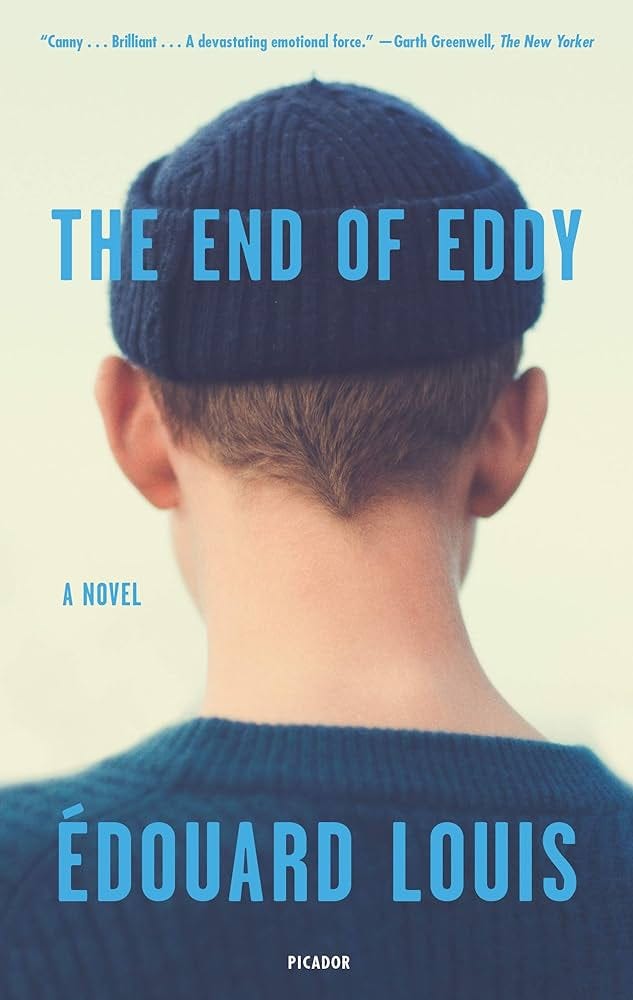
The novel begins, "From my childhood, I have no happy memories. I don't mean to say that I never, in all those years, felt any happiness or joy. But suffering is all-consuming: it somehow gets rid of anything that doesn't fit into its system." It is a sobering opening, to say the least – but it is self-evident that the read-ahead will not be the coming-of-age story you are accustomed to reading.
The End Of Eddy is a compressed, beautiful parcel of autofiction about Louis' painful and violent childhood growing up gay in a poor village in northern France. Where all he wanted more than anything was to be "a tough guy." It is a sensitive and visceral portrait of boyhood and sexual awakening – and at its core, an exploration of violent systems and their victims.
Louis brings to light the unseen violence in his village by voicing the silent suffering created by the systems of poverty. The novel traverses between the voices of the critical characters of Eddy's childhood and that of the reflecting narrator, Edouard. With this dynamic, we are able to both feel the truth of the pain on the page and the clarity of reflection that only time would allow — a successful blend of literature and sociology.
If you are a devotee of Toni Morrison's novels, you'll find familiarity in this book. As Morrison's legacy of shedding light on the enduring impacts of racism, hatred, and their detrimental effects on American society — Louis makes relevant the impact of oppressive systems upon the working class and their effects on French Society.
“In the world I grew up in, being different was dangerous.”
― Édouard Louis, The End of Eddy

